Email Marketing · Part 6
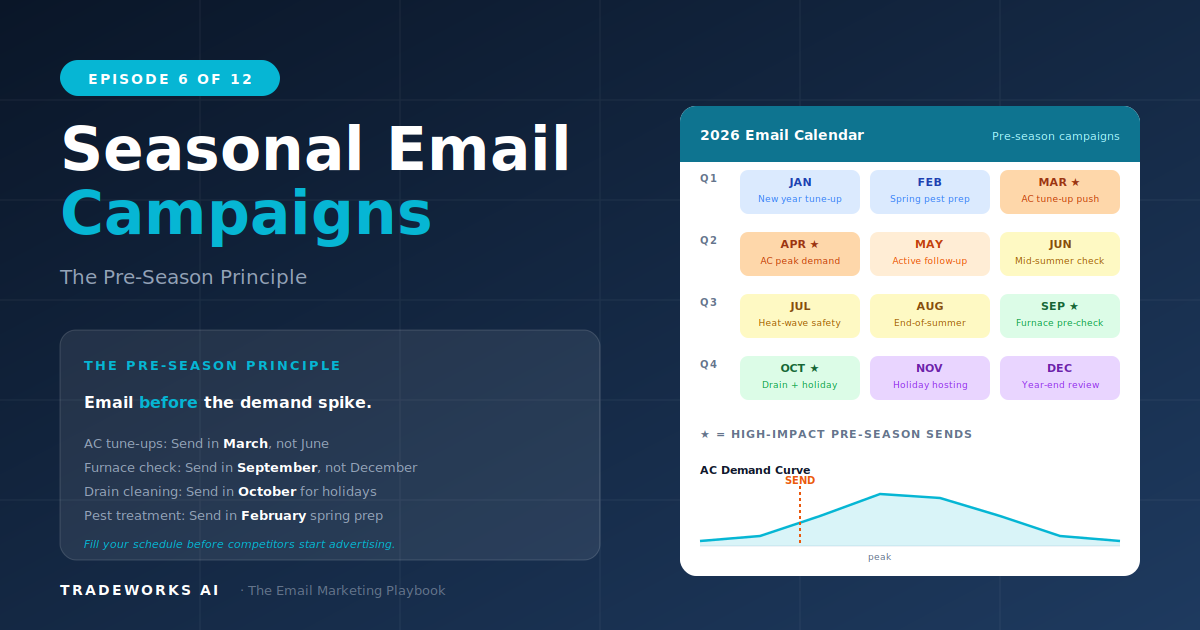
Seasonal Email Campaigns
The pre-season principle and 4-email sequence by trade.
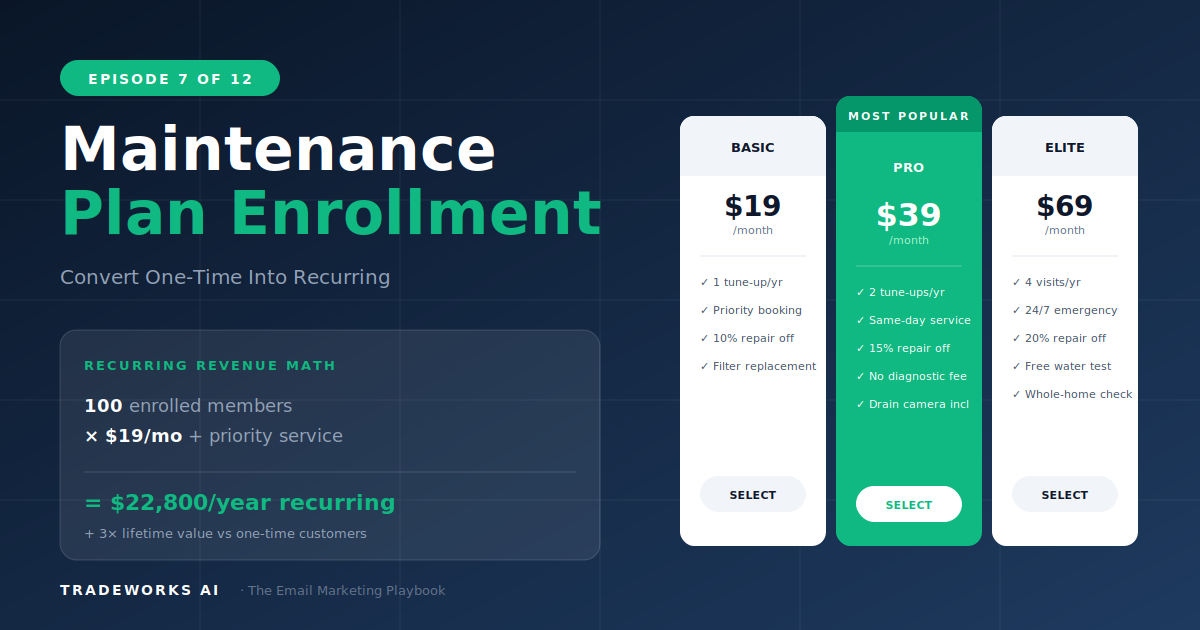
A maintenance plan customer is worth 4.5 to 6 times more than a one-time service customer over a five-year period. For a typical HVAC contractor, a one-time repair customer generates an average of $450 in revenue and a 35% probability of ever calling again. A maintenance plan member generates $2,400–3,600 over five years through annual plan fees, priority service visits, discounted repairs, and equipment replacement revenue when their system reaches end-of-life.
The email sequence that converts one-time customers into plan members is a three-email post-service automation that launches 48 hours after job completion, reinforced by a technician handoff during the service visit. Contractors running this sequence convert 12–22% of eligible one-time customers into maintenance plan enrollees.
Most home service contractors operate on a transactional model. A customer calls with a problem. You fix it. You send an invoice. The customer disappears until the next problem. This model has three structural weaknesses that maintenance plans solve:
Businesses with strong recurring revenue sell for significantly higher multiples. A contractor with 40% plan penetration is a fundamentally different asset than one relying entirely on one-time calls.
All standard benefits plus additional tune-ups, indoor air quality services, water quality testing, or multi-system coverage. Premium plans work best for contractors who serve multiple trades or have high-value add-on services.
The email sequence does not work in isolation. It works as the second touch in a two-touch enrollment process. The first touch happens on-site during the service visit.
The technician's role:
Customers who heard about the plan from their technician convert at 2–3x the rate of cold email-only enrollment.
Subject lines:
Body: Open with a personalized service recap: what was done, who did it, and any observations the technician noted. "[Technician] noted that your capacitor tested at 85% of rated value. It is working now but will likely need replacement within the next 12 to 18 months." Transition to the plan with bullet-point benefits and a link to the dedicated plan page.
Goal: Overcome the cost objection by showing the financial comparison.
Body: Present a clear cost comparison. "Annual plan: $189. A la carte: 2 tune-ups at $129 each + 15% repair savings on average $400 in repairs. The math: plan members save $342 per year." Specific example: "Last summer, plan members who needed a capacitor replacement paid $285 instead of $380."
Subject lines:
Body: Lead with social proof: number of active plan members, satisfaction rating, testimonial quotes. Add a time-limited enrollment incentive: waive first month's fee, include a free add-on service, or lock in current annual rate.
The real power becomes clear over a 5-year customer lifecycle:
That single $8,000–15,000 replacement job captured at an 85% close rate is the entire business case for maintenance plans.
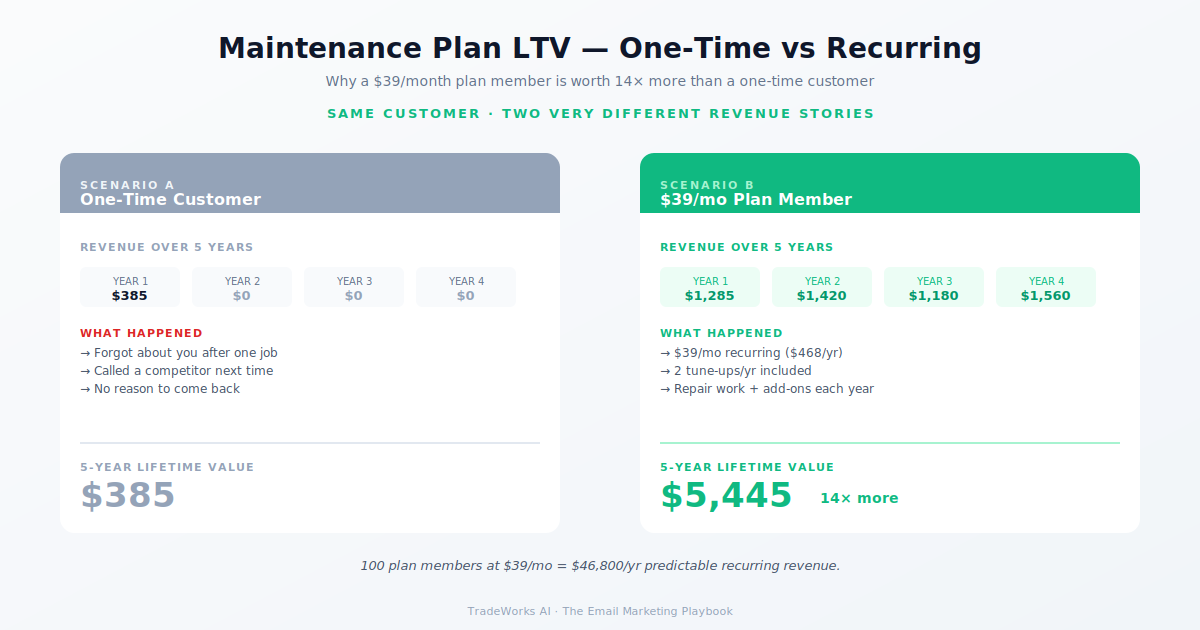
Maintenance plans transform contractor businesses from transactional to relational. Predictable monthly revenue. Higher retention. Captured replacement jobs. Higher business valuation. The 3-email sequence is the conversion mechanism. The technician handoff is the multiplier. Read Part 8 next: turning satisfied customers into your sales team.
12–22% of eligible one-time customers, with the higher end for customers who received an on-site introduction from the technician. Without the technician handoff, expect 5–10% from email alone.
Offer both. Monthly billing has a lower barrier to entry and higher initial enrollment rates. Annual billing has lower administrative overhead and lower churn. Most contractors see a 60/40 split favoring monthly at enrollment, with many switching to annual after the first year.
Do not offer plans to customers with equipment that is clearly at end-of-life (18+ years for AC, 12+ years for water heaters). Instead, focus on replacement conversations. Enrolling a customer in a plan for equipment that will need replacement within 12 months creates a poor experience.
Send a cancellation survey email to understand the reason. The most common reasons are cost, forgot they had it (solved by the annual review email), and moved. For cost-related cancellations, offer a 3-month rate reduction. For move-related cancellations, ask for a referral to the new homeowner.
Yes, but commercial plans are structured differently: quarterly inspections, guaranteed response times, dedicated account management, and annual contracts with automatic renewal. Commercial plan pricing is typically $500–2,500 per year per system.
At minimum: technician notes/tags from the service visit (Interested/Considering/Declined) syncing to your email platform via Zapier. ServiceTitan Marketing Pro does this natively. Mailchimp/ActiveCampaign with Zapier requires a 15-minute setup.
Most contractors capture 2-5% of eligible customers into recurring revenue. The right post-service automation gets you to 12-22%. Our free audit shows where the gap is in your funnel.
The pre-season principle and 4-email sequence by trade.
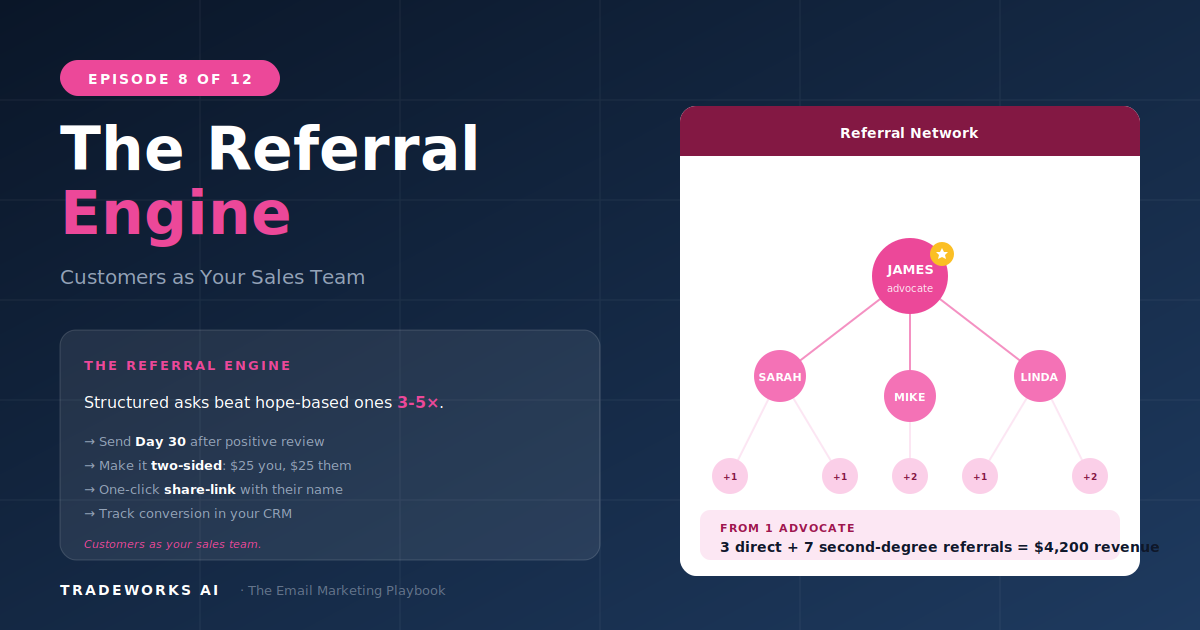
2-email post-service sequence with dual-sided incentives.